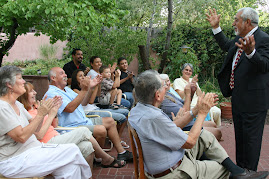
District 6 City Councilor Rey Garduño has been appointed to the following Committees for the upcoming year:
Land Use, Planning & Zoning Committee; Councilor Garduño served on this Committee last year and will continue to assure that the land use policies for the City are serving the community and not burdening them.
Albuquerque / Bernalillo Water Authority; One of Councilor Garduño's passions is water and policies that conserve and protect our water. He will be an essential voice on this increasingly crucial board.
Public Safety Committee - Chair; During his campaign and first year on the Council, Garduño has stressed the importance of prevention and intervention programs play in the larger scope of Public Safety, along with Police and Fire Departments. Councilor Garduño will assure that programs will be available and accessible to ensure community safety.
Regional Transit District; Another issue that Councilor Garduño has continually pushed is the efficiency and accessibility of public transportation. He will continue to serve on this board to keep improving the transit in the mid-region of the state.
Other appointments include Albuquerque / Bernalillo County Government Commission, Accountability in Government Oversight Committee, Committee on Guidelines for Negotiations, Internal Operations, Community Schools, Hispano Chamber of Commerce.
Thursday, December 18, 2008


Wednesday, December 17, 2008
Vayamos a Santa Fe
Rail Runner Express kicks off its public schedule today
By Trip Jennings 12/17/08 9:06 AM
 The New Mexico Rail Runner commuter train officially begins running to Santa Fe today, and, in fact, already has made its first journey to the City Different. The first train left Los Lunas a little before 5 a.m.
Gov. Bill Richardson made the Rail Runner a major priority and took his own ride on the train Monday, where he waxed poetically — and sometimes hyperbolically — about what the train would do for New Mexico and the world at large.
As someone who loves trains and rode up with the guv on Monday, I thought the train was a nice ride, especially for those of us who travel to Santa Fe more than once a week. The only gripe I have is that the wireless Internet that state officials promised business commuters is not up and running yet. But state transportation officials told me Monday it will be available in about a month.
I did a lot of reporting when I was with the Albuquerque Journal on the Rail Runner project and on some legislators’ concerns about the cost of the project ($400 million). There seemed to be some very legitimate questions. But it will be years before we know what kind of legacy Richardson’s Rail Runner is for the state of New Mexico. Until then, I’d encourage people who are interested in the train to try it out.
Here’s a Web page with the Rail Runner’s schedule.
Wednesday, December 10, 2008
Human Rights Week
Tonight is the culmanation of Human Rights Week in Albuquerque with a program being sponsored by the Albuquerque United Nations Association and Veterans for Peace. The event will take place at Smith-Brasher Hall, which is on the corner of University and Coal, at 6pm.
The moderator for this event is your very own District 6 City Councilor Rey Garduño.
Here is program schedule;
6:00 pm – Refreshments
7:00 pm - Program: MODERATOR: Rey Garduno, member of
Albuquerque City Council
Songs by The Raging Grannies
Introduction of Moderator
Reading of City Proclamation
Reports by participating organizations
Awarding of Essay Contest Prize by Veterans for Peace
Reports of other organizations
SPEAKER: Ladonna Harris, President of Americans for
Indian Opportunity (AIO)
Questions and Discussion; A Charge to Protect
Monday, December 8, 2008
Special Council Meeting Tonight
Tonight at 5pm in the Vincent E. Griego Council Chambers, the City Council will hold a special meeting to hear Election Code/Municipal Elections Bills that were defered from the last Council meeting on December 1st.
At that meeting Vice-President Sally Mayer asked to have these bill discussed and voted on together at a Special Meeting.
These bills are resolutions to some problems that occurred during the first public financed election in Albuquerque in October 2007.
The Bills are O-08-52, O-08-53, and O-08-54;
These bills if adopted:
Also, to be heard is R-08-142;
At that meeting Vice-President Sally Mayer asked to have these bill discussed and voted on together at a Special Meeting.
These bills are resolutions to some problems that occurred during the first public financed election in Albuquerque in October 2007.
The Bills are O-08-52, O-08-53, and O-08-54;
These bills if adopted:
(1) increases the number of campaign finance reports from six to nine. In
addition it requires campaign contributions of over $250 for a Council election
and over $500 for a Mayoral election to be reported the following day if
received in the week preceding an election;
(2) defines the word "expenditure" for purposes of requiring a campaign
finance report. An "expenditure" under the bill would include the creation of an
obligation to make a payment or provide a service. This is an attempt to deal
with the problem of a candidate incurring an obligation but not paying or
reporting that obligation until later, including after an election; and,
(3) allows a single form to be used both to receipt a five dollar
qualifying contribution and as a candidate petition. Legislation sponsored by
Councilors O’Malley, Benton and Garduno.
Also, to be heard is R-08-142;
This bill if adopted would call on the City Clerk to initiate the process
to amend the regulations governing the Open and Ethical Elections Ordinance. The
bill does not mandate any change but does request that certain changes be
considered. The changes for consideration are:
(1) specifying the time of day when the Qualifying Period ends; and
(2) specifying that seed money is deducted from the amount of public funds
distributed; and,
(3) allow funds to be expended on the last three days before an election if
it is determined that such amounts are to be distributed even if those funds
have not yet been distributed.
Friday, December 5, 2008
San Juan-Chama Drinking Water Project

Today is the offical grand opening of the San Juan-Chama New Surface Water Treatment Plant.
This morning the Agua Es Vida Action Team and Amigos Bravos held a press conference and highlighted some of the issues with the San Juan-Chama Drinking Water Project:
· After more than 30 years of San Juan-Chama water flowing in the Río Grande, the river ecosystem, the Bosque, those with domestic wells, and other users have become dependent on those flows; removing them will cause harm.
· Removing up to 94,000 acre feet per year (afy) of water from the river between the Alameda diversion point and the south side wastewater treatment discharge near Río Bravo will seriously dewater the river as it flows through the heart of the city, harming the Bosque and the river ecosystem.
· Dewatering this long stretch of the river will deprive the aquifer of a significant source of recharge.
· Dewatering the river will aggravate the already very large impact on the river
from decades of groundwater pumping, which has led to an estimated loss from the
river of almost 70,000afy (Albuquerque uses a little over 100,000 afy by comparison). The WUA will likely need to find water rights to cover this loss, which has been masked by the flows from the San Juan-Chama water.
· Dewatering the river will increase the impact of the wastewater discharge, which will be more concentrated as it enters the river. Several studies of this part of the river confirm two national surveys documenting the relationship between wastewater discharges and the presence of pharmaceuticals, endocrine disrupting compounds (like steroids and estrogen), and personal care products (like insect repellant and sunscreen) in rivers. The impacts of these chemicals on aquatic life are becoming well documented and studies are beginning to suggest an impact on humans from chronic low-dose exposure to these same chemicals.
· Removing the San Juan-Chama water from the system and plans that the WUA has for additional withdrawals means that the burden of finding sufficient water rights to meet a variety of deficits will fall on agriculture. The WUA is already seriously deficient in required water rights to offset its activities. While many believe agriculture “wastes” water, the irrigation system and water put on fields now is a major source of aquifer recharge, a job originally performed by the river. Furthermore, analysis of the amount of water rights that the WUA (and others in the region) would need in order to get into compliance with water law in the state greatly exceeds ALL the agricultural water rights held in the Middle Río Grande; taking them would turn the region into a brown and lifeless zone.
Subscribe to:
Posts (Atom)